
Firm Bulletin: 2027 Fees for Participating Firms

How OBSI fees are determined
As a not-for-profit organization, OBSI recovers all its budgeted operating expenses from its participating firms each year. OBSI's budget and the allocation of this budget between the different industry sectors that use our services is approved by our Board of Directors each September. Our board also considers fairness and the impact of fee changes on member firms when setting fees. A guiding principle is that no sector or registrant category should subsidize another.The allocation of the budget among industry sectors is based on each sector's proportionate use of our service. This is determined by the total number and complexity of the cases opened for each sector in the previously completed year. Once the budget has been allocated to each sector, fees for each firm in the sector are determined.
Additional information about OBSI's fee structure is available here.
Growing demand requires continued investment in service capacity
OBSI's budget is set at a level required to recover the estimated cost of providing our services in the coming year. A key factor that determines our resource needs is expected consumer demand, including the volume of case inquiries and investigations we anticipate handling.
Consumer demand increasing sharply
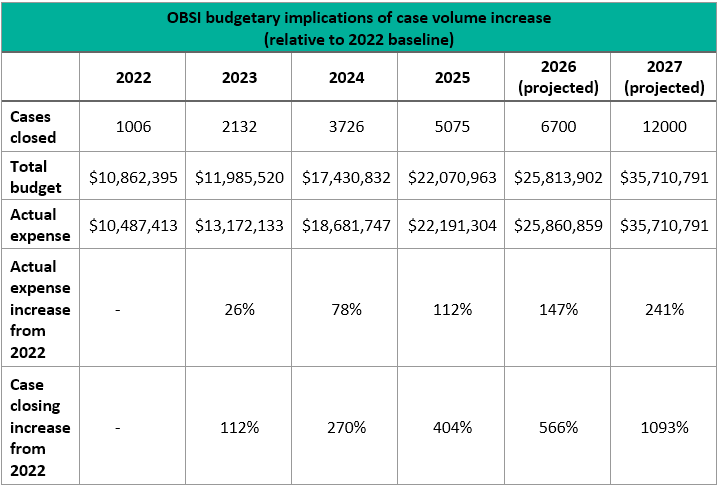
Consumer demand for OBSI's services has increased dramatically in recent years, with annual case volumes rising from approximately 1,100 in 2022 to more than 9,000 in 2026. Both banking and investment cases have reached new all-time highs in 2026.
Looking ahead, we expect demand to continue increasing across both the banking and investment sectors. Based on current trends, total case volumes are expected to reach approximately 12,000 cases in 2027, an increase of approximately 25% over 2026 projected levels and double the level of demand experienced in 2025.
Investing to meet demand
To maintain service standards and respond to this growth, OBSI's 2027 operating budget has been set at approximately $35.7 million, an increase of 38% over projected 2026 expenses. More than 85% of OBSI's operating costs relate to personnel, and the budget increase primarily reflects the staffing growth required to address the sharply increasing complaint volumes.
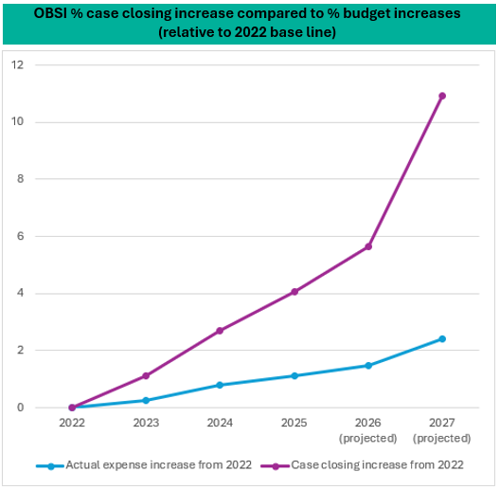
As demand for our services has increased, we have remained focused on improving productivity and operational efficiency. As a result, we expect to close approximately 12 times as many cases in 2027 as we did in 2022, while operating with approximately three and half times the budget.
These results reflect significant economies of scale and scope, ongoing investments in operational improvements and OBSI's commitment to delivering services as efficiently as possible.
Building OBSI's reserve fund and technology modernization
In addition to recovering operating expenses, 2027 fees include $3 million to strengthen our reserve fund.
Maintaining adequate reserve funds helps ensure OBSI can respond to unexpected increases in demand, manage unforeseen costs without creating significant fee volatility for participating firms. Our reserve fund also allows us to fund major organizational investments, such as our case management system modernization project which will renew our core technology platform and position us for future growth.
The reserve contribution is separate from the $35.7 million operating budget and will be added directly to the reserve fund rather than used for day-to-day operating expenses.
2027 participating firm fees
While total fees are increasing in 2027, most of the increase is attributable to the banking sector, which continues to account for the largest share of OBSI's complaint volumes and recent growth in consumer demand.
Banks: Fees for the banking sector will increase by 49% relative to 2026.
Please note this does not mean the fees for all banks will increase by this amount. Individual bank fees are calculated based on size and case experience as described here. Banking complaints continue to represent the largest share of OBSI's workload (88% of all opened cases in 2026) and remain the primary driver of consumer demand for our services. Banks and federally regulated financial institutions with three-year average case volumes of less than one complaint per year will continue to be charged a flat annual fee of $2,500.
Credit Unions: Fees for this sector will increase by 20% relative to 2026. In 2022, under a transitional fee model, fees were set at $1 per million of assets while a three-year complaint history was established. With three full years of experience now available, the 2027 fee rate will increase to $1.20 per million of assets based on the growth in complaint volumes for the sector.
Payment Service Providers: Payment service providers (PSPs) are a new participating sector for 2027. As there is no complaint history for this sector yet, participating PSPs will initially be charged a minimum annual fee of $500.
CIRO Firms: As previously communicated, OBSI will implement a new fee model for CIRO firms beginning in 2027. Under the new model, Investment Dealers and Mutual Fund Dealers will no longer be assessed separately. For 2027 and future years, the allocation of fees among individual CIRO member firms will be made on same basis as is used by CIRO pursuant to their new integrated fee model – i.e., based on count of approved persons and adjusted revenue (including AUA for all mutual fund dealers). OBSI fees will be allocated among CIRO member firms in the same relative proportion as CIRO’s fees are allocated. Additional information about the new fee model is available here. Overall, fees for CIRO firms will increase by 18% relative to 2026. This fee increase is in line with case volume growth for the sector.
Exempt Market Dealers and Portfolio Managers: Fees for this sector will increase by approximately 9% relative to 2026. Fees on a per-representative basis will increase to $128, up from $117 in 2026.
Scholarship Plan Dealers: Fees for this sector will decrease by approximately 11% relative to 2026, reflecting reduced complaints from the sector.